
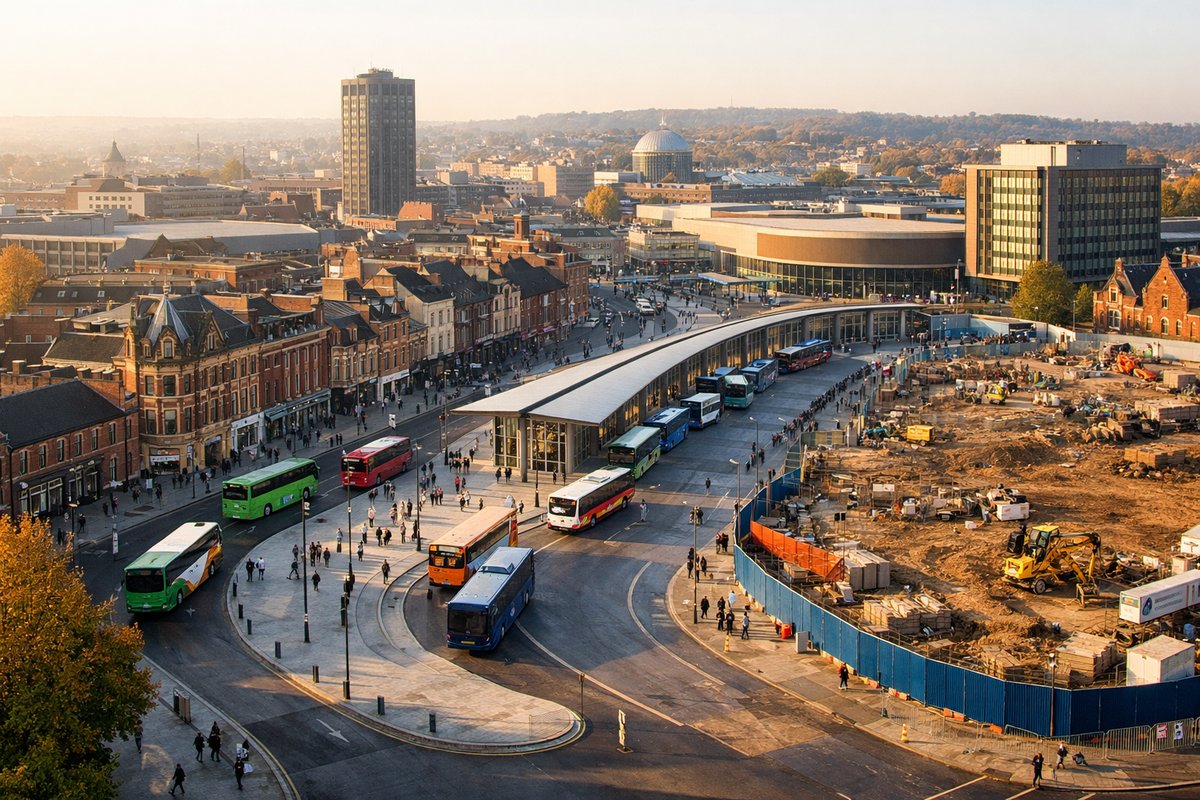
Stoke-on-Trent is getting more than £105 million in new government transport investment between April 2026 and March 2030. That covers highways, buses, junctions, active travel and a set of new interchanges that will physically change how people and goods move around this city.
Most local business owners treat that as background noise. It is something the council does. It is roadworks outside the shop. It is a press release they scroll past.
That is a mistake, but it is an understandable one in a city that has been promised transformational investment before and seen it arrive slowly, or not at all. Stoke-on-Trent is post-industrial in a way that Milton Keynes simply is not. Wages here sit below the national average. Connectivity has historically been a constraint on who can realistically work here, shop here, or do business here. That is precisely why this programme matters more to a Stoke SME than a comparable sum would matter to a city that is already well-served. The businesses that position themselves now, before the work is even finished, will capture the growth that arrives when it is. The ones who wait will find the market has already moved.
Why Stoke-on-Trent’s £105 Million Transport Upgrade Matters to Every Local Business Owner

The £105 million settlement announced in March 2026 is not a single project. It is a structured programme split across an Integrated Transport Fund and a Bus Services Fund, covering everything from junction upgrades to entirely new bus corridors. It runs until 2030.
The Infrastructure Delivery Plan published in August 2026 confirms new transport interchanges at Hanley and Longton, an expanded Bus Service Fund through to March 2029, and the Integrated Transport Fund locked in until March 2030. This is a four-year window of continuous physical change to the city.
The January 2026 Joint Strategic Transport Statement, produced jointly by Stoke-on-Trent City Council and Staffordshire County Council, makes the economic intent explicit: the goal is to drive sustainable growth, improve access to jobs and enhance multi-modal connectivity across the whole region.
That translates directly to three things that change the conditions for your business: a wider labour catchment, a larger customer radius and a more accessible supplier base. Each of those is a growth lever, if you are prepared for it.
The honest flip side matters too. The September 2025 Infrastructure Capacity Study acknowledges that major transport programmes create short-run disruption. Roadworks suppress footfall. Diversions change routes people use habitually. If your business depends entirely on passing trade and you have no digital presence, the next four years could actually hurt you before they help you.
How Better Roads and Buses Directly Expand Your SME’s Sales Catchment Area

Here is the mechanism that most commentary on transport infrastructure skips over: connectivity does not just reduce journey times. It changes who can realistically buy from you, work for you and supply to you.
Imagine a corridor that cuts a journey from the outer Potteries into Hanley from something unreliable and slow to a dependable sub-15-minute trip. The pool of customers who will consider making that trip for your product or service grows. If the new interchange at Longton makes onward connections to Stafford and Newcastle-under-Lyme more predictable, your B2B sales radius expands without you changing anything about the product itself.
The 2025-2026 Investment Prospectus goes further. It sets out plans for new local rail stations within the conurbation and a new multi-modal hub linking the city centre to the main railway station. When those land, the question for a North Staffordshire SME is not “is this good news for the city?” It is: which of my current customers now have a faster route to me, and which new customers become reachable for the first time?
The connectivity gap that these investments are designed to close is real. The National Audit Office’s DfT Overview for 2024-25 introduced a national connectivity metric with scores ranging from 61.9 in the South West to 85.8 in London. Stoke-on-Trent’s specific score is not published in that document, but a city with Stoke’s post-industrial transport history does not sit near the top of that range. Every improvement in that score represents real minutes saved for real people making real decisions about where to spend money and where to work.
Mapping the Opportunity: Which Projects to Watch Between Now and 2030

Not all of the £105 million is equally relevant to every business. Here is where to focus your attention depending on your model.
The Hanley and Longton transport interchanges
These are the highest-visibility projects in the Infrastructure Delivery Plan. Hanley is the commercial core of the city. Longton serves the southern arc of the Potteries. Both interchanges will concentrate footfall and dwell time around specific nodes. If your business is physically near either of these locations, or if you serve customers who travel through them, these interchanges directly affect your catchment.
The rapid bus transit network
A dedicated rapid bus transit network changes the competitive geography of the city. Routes that were unreliable become dependable. That is significant for service businesses that rely on staff arriving on time from across North Staffordshire, and for retail and hospitality businesses whose customers weigh up whether the journey is worth making.
The Ceramic Valley Enterprise Zone and Etruria Valley
The Etruria Valley Link Road, completed in recent years, already changed the logistics map for businesses near junction 15 of the M6. The Ceramic Valley Enterprise Zone continues to attract manufacturing and distribution businesses to the area. If you supply goods or services to industrial businesses, this zone and its surrounding transport connections represent a growing B2B market on your doorstep. The question is whether your pipeline is set up to reach it, before new competitors arriving alongside you get there first.
A note on HS2
Phase 2a to Crewe, which would have brought material benefits to Stoke-on-Trent through onward connectivity, was cancelled. The Joint Strategic Transport Statement acknowledges this directly and calls for an alternative involving upfront partnership with government. I am not going to pretend that is not a setback for the city’s long-range connectivity ambitions. It is. But the programmes that are funded and confirmed (the £105 million programme, the interchanges, the rapid bus network, the multi-modal hub) are real, locked in and happening regardless of what occurs at the national rail level.
Building a Marketing Funnel That Grows With the City, Not After It
This is where most commentary on transport infrastructure stops being useful. It tells you better transport is good for the economy and then leaves you to figure out what to do about it.
Here is the operational point: infrastructure creates demand conditions. It does not create demand by itself. The businesses that benefit are the ones that have already built the capacity to capture new customers when those customers arrive.
Think about what actually happens when the Hanley interchange is finished and footfall increases around the bus terminal. When I was building out the commercial side of Hit the Drop, the lesson that hit hardest was this: if the audience arrived before you had a system to catch them, they left and found someone who did. The principle is identical here. If your business has no visibility in the areas the new routes serve, no Google Business Profile optimised for local search, no targeting of the relevant postcodes, and no follow-up system for new enquiries, that footfall does not become your revenue. It becomes someone else’s.
The short-run disruption point matters here too. During construction phases, digital channels become relatively more important. Independent retailers in Hanley and food-and-drink operators around Longton are the businesses most exposed to this risk: a customer who would normally walk past your window now has a diversion route that takes them past a competitor. If your online presence is strong enough to reach them before they even leave home, the diversion route is irrelevant. If it is not, you are relying on physical proximity that the roadworks are temporarily removing.
What to Do Before the Infrastructure Opens: A Practical Sequence

Here is a practical sequence for a North Staffordshire SME looking to use this infrastructure cycle as a growth catalyst. I have split it into two phases, because the actions before the infrastructure lands are different from the ones you need when it opens.
Before the infrastructure lands
- Map your catchment radius now. Where do your current customers come from? Which postcodes are under-represented relative to their population? The transport improvements are most likely to bring you customers from areas where your current conversion is lowest, because those are the areas where journey friction was highest.
- Build geo-targeted campaigns for the postcodes the new bus routes serve. This is not speculative. The route plans are published. You can build a Google Ads or Meta campaign targeting households within 500 metres of a new interchange before the interchange exists. When it opens, the campaign is already optimised and has collected real performance data. A local Google Ads campaign for a Stoke service business typically needs three to four months of data before cost-per-acquisition figures become reliable. Start in late 2026 and you are ready well before the first interchange opens.
- Optimise your Google Business Profile for the Hanley and Longton interchange catchments. Local search is the first thing a new customer does when they arrive somewhere they have not been before. If you are not visible in that search, you are not in the consideration set.
- Strengthen your brand before the zone fills up. Infrastructure investment attracts inward investment. The businesses moving into the Ceramic Valley Enterprise Zone are potential customers, but they also arrive with existing suppliers. A brand established before they arrive is harder to displace than one you are building at the same time as new competitors are setting up alongside you.
When the infrastructure opens
- Automate your enquiry follow-up. Increased footfall and reach brings increased enquiry volume. If your follow-up process is manual (someone reads the email, someone else calls back two days later), you will convert a fraction of the enquiries you receive. A basic CRM automation sequence handles initial response and qualification without your team touching it, which means more conversions from the same volume of interest.
- Review your delivery or service radius. If you currently restrict delivery or service calls to a set area, better transport infrastructure changes the cost and time assumptions that radius was based on. A route that was not viable at 45 minutes may be perfectly viable at 25.
None of this is particularly complicated in isolation. The difficulty is doing all of it while running a business. That is where automation earns its keep: if your admin, reporting and customer communications are running automatically, your team’s time goes to the work that actually requires human judgement.
If you are a Staffordshire business thinking about how to stretch your capacity without adding headcount, that is precisely the kind of problem I work on through Wright Advisory. The actual work is finding where AI systems can replace manual admin and repetitive processes in your specific business, building those systems on your own data and SOPs, and measuring the result against your own KPIs. Not a seminar. Not a generic software subscription. Operational AI, built for your specific business. If that sounds relevant, book a free discovery call and we can work out in 30 minutes whether there is something worth building.
What Stoke-on-Trent SMEs Should Do Before 2027
Transport infrastructure and economic growth are connected at the city level. That is not in dispute. The planning documents, the investment decisions and the regional strategy all point the same direction.
The question for a Stoke-on-Trent business owner is more specific: how do I make sure the growth that comes from this £105 million programme flows to my business, not past it?
The answer is not to wait and see. It is to build the pipeline, the brand and the automation now, so that when the infrastructure opens up new customers and new routes to market, you are already there waiting for them.
Stoke-on-Trent has a confirmed four-year infrastructure programme running to 2030. Use it.
Leave a Reply