
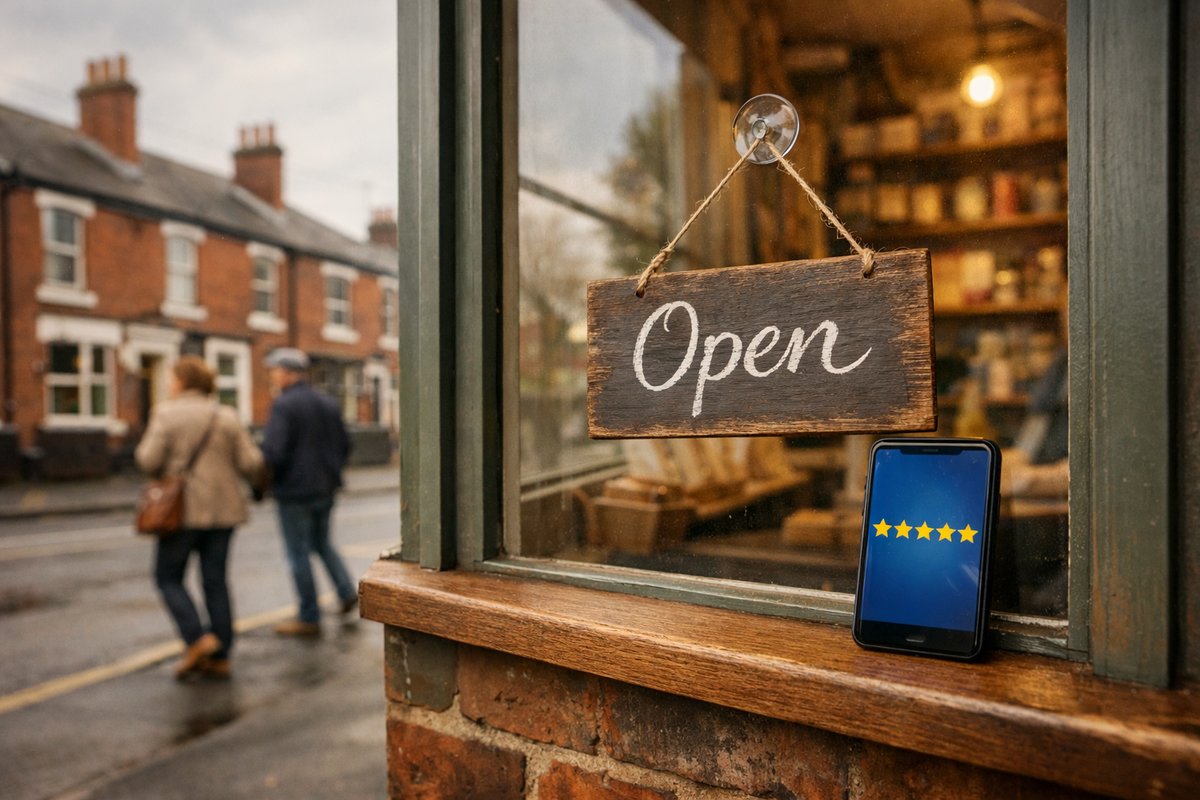
If you run a local business in Stoke-on-Trent and you are not actively collecting Google reviews, you are handing customers to competitors who are. That is not an opinion. BrightLocal’s Local Consumer Review Survey 2026 found that 41 percent of consumers now always read reviews before choosing a business, up from 29 percent the previous year. That is the sharpest single-year jump on record. And 68 percent will only use a business with four or more stars.
In the Potteries, where trades, hospitality, and independent retail compete on local trust rather than national brand recognition, reviews are your most scalable sales asset. This guide gives you the full playbook: from locking down your Google Business Profile to building a repeatable review system using tools that Stoke start-ups can actually fund.
Why Google Reviews Matter More Than Ever for Stoke-on-Trent Businesses in 2026


The 2026 Consumer Shift: Star Ratings Now Drive Business Selection
The numbers from BrightLocal’s 2026 survey should be pinned to every Stoke business owner’s desk. Forty-one percent of consumers always read reviews before choosing a business, up from 29 percent the previous year. Sixty-eight percent will not use a business with fewer than four stars. Thirty-one percent now require 4.5 stars or above before they will even pick up the phone.
That last figure is the one that should make you stop. Nearly a third of your potential customer base has set a bar that rules out most Stoke SMEs right now. If your profile is sitting at 3.8 stars with a handful of reviews from three years ago, you are invisible to a significant slice of the market before they have even read your website.
How Review Velocity Beats Review Count in Local Search Rankings
Raw review count matters, but velocity matters more than most people realise. Profiles that maintain a steady stream of new reviews tend to outrank slower-moving competitors in local search results. Profiles with 50 or more reviews consistently win more clicks than those with fewer than five. Cross the 100-review milestone and the compound effect on lead volume becomes measurable.
There is also the AI Overview shift to factor in. In 2026, Google’s AI-generated answers to local searches are pulling directly from well-reviewed Google Business Profiles. If someone in Hanley types “best plumber near me,” Google’s AI summary is more likely to surface a business with consistent recent reviews and keyword-rich responses than one with a dormant profile. Reviews are no longer just a trust signal. They are a visibility signal in a zero-click search environment.
As someone building tools and guidance for Stoke SMEs, I have watched the competitive bar rise sharply this year. Businesses without a structured review strategy are losing discoverability not just in the Maps pack but inside AI-generated summaries that answer local searches before a user ever clicks a result.
Set the Foundation Right: Claiming and Optimising Your Google Business Profile
Verify Your GBP and Lock Down NAP Consistency Across Stoke Directories
Before you ask a single customer for a review, your Google Business Profile needs to be verified and fully completed. An unverified or half-built profile wastes every review you collect. If your business name, address, and phone number (NAP) differ between your GBP, your website, Yell, Yelp, and local Stoke directories, Google’s algorithm treats those inconsistencies as trust signals in the wrong direction.
Go through every directory your business appears in: Yell, Yelp, Checkatrade (critical for trades businesses across North Staffordshire), TripAdvisor (essential for hospitality in Hanley and Burslem), and any local Stoke business listings. Make your NAP identical everywhere. It is not glamorous work, but it is the foundation everything else sits on.
Complete Your Profile: Categories, Hours, Photos, and Service Descriptions
A completed GBP profile increases the acceptance rate of review requests because it looks credible when a customer clicks through from your review link. Choose your primary and secondary categories carefully. A Longton-based electrician should not just sit in “Electrician.” Adding categories like “Electrical installation service” and “Lighting contractor” captures more search intent.
Add real photos: your team, your work, your premises if you have them. Businesses with photos receive significantly more direction requests and website clicks, according to Google’s own published guidance. Write your service descriptions in plain English, not keyword soup. Include the areas you serve. “We cover Stoke-on-Trent, Newcastle-under-Lyme, Stafford, and the surrounding areas” is exactly the kind of natural local signal that both customers and Google’s algorithm recognise.
If I were launching a local service business in Stoke today, I would spend two hours locking down my GBP profile before asking a single customer for a review. A half-optimised profile wastes every review you collect.
How to Ask for Google Reviews Without Breaking UK Rules

The CMA and Google Rules: What You Cannot Do
Before any tactics, one hard stop. Do not offer discounts, freebies, cash, or entry into a prize draw in exchange for a review. Google’s Terms of Service prohibit it. The UK Competition and Markets Authority (CMA) guidelines on fake and misleading reviews also apply to incentivised reviews, and the Consumer Rights Act gives enforcement teeth to those rules.
The practical risk is real: your Google Business Profile can be suspended, and a suspension at peak trading season can cost a Stoke trades business weeks of enquiries. Generic US advice on review acquisition often skips this entirely. Do not follow it.
Ethical Ask Strategies: Email, QR Codes, WhatsApp, and Invoices
The most effective review requests are personal, timely, and frictionless. Here is how that looks across the main Stoke SME sectors.
- Trades businesses (plumbers, electricians, builders across Stoke and Staffordshire): Generate your Google review link via your Place ID (find it in your GBP dashboard) and send it via WhatsApp within one hour of job completion. A short, honest message works better than a template. Something like: “Really glad we could help today. If you have two minutes, a Google review makes a huge difference to a small local business. Here is the link.” Leave a printed QR code card on-site as a fallback for customers who prefer to review later.
- Hospitality (restaurants, cafes, bars in Hanley, Burslem, Tunstall): A review prompt on the receipt, a table card with a QR code, or a follow-up text for bookings made online. Time the ask at the peak of a positive experience, not at the door on the way out.
- Professional services (legal, accountancy, consultancy): Embed the review link in your project completion email or invoice. The moment the client marks a project as done is your highest-leverage window.
- Retail (Fenton, Longton, city-centre independents): A QR code near the till with a short handwritten-style prompt. Keep it low-pressure. You are making it easy, not demanding.
Stoke’s trades sector sits at the lower end of review averages nationally. A WhatsApp or QR code request at job completion is not pushy. It is operationally smart, and it converts far better than generic email blasts sent days after the work is done.
Timing Your Request for Maximum Conversion
The single most important variable in review acquisition is timing. Ask at the moment of peak satisfaction: immediately after a job is completed, a meal is enjoyed, or a project is signed off. Wait 48 hours and the emotional moment has passed. Wait a week and the customer has moved on entirely.
Build the ask into your operational process so it is not an afterthought. If you have a job completion checklist (and you should), add “Send review link via WhatsApp or text” as a standard step. If you send invoices, embed the review link in the footer as a default. Make it a system, not a favour you have to remember to ask.
Building a Review Velocity System: Targets, Automation, and Funded Tools
The 50-Review Milestone and a Weekly Velocity Target
Set two concrete targets. First, reach 50 reviews. That is one of the highest-leverage milestones in local SEO, the point at which your GBP profile starts winning meaningfully more clicks over competitors with fewer. Second, maintain at least one new review per week once you pass that threshold. That velocity keeps you ahead of slower-moving competitors in the local pack rankings.
For a busy Stoke trades business doing 10 to 20 jobs a week, hitting one review per week from a structured ask process is entirely achievable within the first month. For a hospitality business with 50-plus covers a day, the benchmark should be higher. Work backwards from your transaction volume to set a realistic weekly target, then build the ask into your operational workflow.
Review acquisition is not a one-off task. It is a repeatable sales funnel. Reviews feed GBP ranking, ranking feeds discovery, discovery feeds enquiries, enquiries feed revenue. The businesses winning local search in Hanley, Etruria, and Burslem in 2026 are the ones treating this as a system, not a campaign.
Free and Funded Tools for Stoke SMEs: UKSPF Grants and Growth Hub Support
If you are a new Stoke-on-Trent business (trading under 12 months), the Fly High Start-Up and Enterprise Grant, funded via the UK Shared Prosperity Fund through Stoke-on-Trent City Council, offers between £500 and £3,000 for equipment, technology, website launch, or branding. Review management software, GBP integration tools, and SMS follow-up platforms can all fall under the technology spend criteria. If you have not applied, check the Stoke-on-Trent City Council business funding page for current eligibility and application details.
For more established businesses, the Stoke-on-Trent and Staffordshire Business Loan Fund offers unsecured loans through BCRS for businesses that cannot access standard bank finance. That is a legitimate route to funding the digital infrastructure needed to compete at scale, including the CRM and review automation tools that turn a manual ask process into a hands-off system.
The Stoke-on-Trent and Staffordshire Growth Hub provides free one-to-one advisor appointments and business support events. Contact them on 0300 111 8002 to explore how funded support applies to your specific situation. Stoke’s Growth Hub and UKSPF funding make a proper review velocity system scalable without bleeding cash in the early stages.
Responding to Reviews to Win More Customers and Rank Higher Across Stoke

Response Time Benchmarks and Templates for Positive Reviews
Collecting reviews is only half the job. Responding to them is where most Stoke businesses leave money on the table. Aim to respond to every review within 24 to 48 hours. Faster is better. A business that consistently responds quickly signals to future customers that there is a real, attentive person behind the profile.
For positive reviews, do not just write “Thanks!” That is a missed opportunity. Mention the specific service, mention the area if it is natural (“Really glad the boiler installation went smoothly for you in Fenton”), and add a brief forward-looking line. Those localised, specific responses add keyword relevance to your GBP and feed directly into Google AI Overviews when someone searches for your service in that area.
A simple template to adapt:
“Thank you so much for taking the time to leave a review, [Name]. It was a pleasure working on [the specific job or project] for you in [area]. If you ever need us again or know someone in Stoke-on-Trent, Newcastle-under-Lyme, or Stafford, we would love to help. Thanks again.”
Turning Negative Reviews Into Trust Signals: Public Responses That Recover Relationships
A significant proportion of negative reviews stem from poor communication rather than genuinely bad products or work. That matters, because it means many of your one-star and two-star reviews are fixable at the response stage. Trustpilot’s 2025 research across 600 UK SMEs and 2,000 UK consumers found that 83 percent of consumers are more likely to trust a business that publicly responds to dissatisfied customers.
A negative review is not a failure. It is a public opportunity to show Stoke customers that you take problems seriously. A thoughtful, professional public response to a complaint is often read by many more people than the original review itself.
When responding to a negative review, keep three things in mind:
- Do not get defensive. Even if the review is unfair, a defensive reply confirms to every future reader that you handle criticism badly.
- Take it offline. Acknowledge the issue publicly, apologise for the experience, and invite the reviewer to contact you directly to resolve it. This shows accountability without creating a public back-and-forth.
- Be specific, not generic. “We are sorry you felt that way” is the worst thing you can write. “We are sorry the communication on your job in Tunstall was not up to the standard we set ourselves, and we would like to make this right” is far more credible.
Consistent review engagement, positive and negative, signals active business stewardship to Google’s algorithm and builds the cumulative trust that turns a search impression into an enquiry. That is what a review system should do: not just collect stars, but convert strangers into customers through visible, human accountability.
Your Next Steps: From Zero Reviews to a Competitive Profile
The path is clear. Claim and fully optimise your Google Business Profile. Build your review link and embed it into your day-to-day customer touchpoints: WhatsApp follow-ups, QR code cards, invoice footers. Set a target of reaching 50 reviews and maintaining at least one new review per week. Respond to every review within 48 hours, with specific, localised language that builds keyword relevance and human trust simultaneously.
If you are a Stoke-on-Trent start-up, check the Fly High grant before you spend your own cash on tools. If you are an established business looking to scale the digital infrastructure, the Growth Hub helpline (0300 111 8002) is a free starting point.
Once your review system is running and your GBP is converting local searches into enquiries, the next question is how to build the internal operations and financial systems to handle the growth that follows. That is where Wright Advisory comes in. I work with Staffordshire businesses on internal strategy, financial planning, cashflow forecasting, KPI design, and building the operational infrastructure to scale without chaos. If that sounds like the conversation you need, book a free discovery call and we can talk through what it looks like for your specific business.
Leave a Reply